On 28 Aug 20, Oxley Holdings Limited (“Oxley”) released earnings for the fiscal year ending 30 Jun 20 (“FY20”) and briefed analysts about the company’s results through an earnings call. The company reported its single and largest annual loss of S$275.1m since 2008. Consequently, Oxley lowered its final dividend per share from 0.68 Singapore cent to 0.50 cent per share, but announced a special dividend of 1.0 cent for shareholders.
About Oxley
Founded in 2008 by Mr Ching Chiat Kwong, Oxley is a Singapore-listed mid-sized property developer with a market capitalization of S$934m on 15 Sep 20. The company had completed 31 property developments and launched more than 48 projects across various countries including the UK, Cambodia, Malaysia, China and Australia. As at 30 Jun 20, Mr Ching and Mr Eric Low See Ching (deputy CEO and executive director) own 42.48% and 28.25% of the company’s shares respectively.
Apart from holding stakes in a myriad of international and Singapore projects, Oxley fully owns Pindan Group Pty Ltd, an Australian developer with an operating history since 1977. The group also has a 10% interest in Aspen (Group) Holdings Limited, a Singapore-listed company with a market cap of S$240.9m.
Over the years, Oxley has issued and redeemed nearly S$1.2 billion of bonds (Table 1). The firm has a history of ramping up leverage quickly to take advantage of market opportunities. After the developments are sold and completed, the company deleverages by paying down debt with sales proceeds.
Table 1: List of matured bonds from the issuer
| Issue size (S$ m) | Issue date | |
|
OHLSP 5.000% 05Nov2019 Corp (SGD) - Retail |
300 | 5 Nov 2015 |
|
OHLSP 5.150% 18May2020 Corp (SGD) - Retail |
150 | 18 May 2016 |
|
OHLSP 5.100% 16May2017 Corp (SGD) |
150 | 16 May 2013 |
|
OHLSP 5.100% 05Dec2016 Corp (SGD) |
150 | 5 Dec 2013 |
|
OHLSP 5.150% 31Oct2016 Corp (SGD) |
75 | 31 Oct 2014 |
|
OHLSP 4.750% 23Sep2015 Corp (SGD) |
225 | 23 Sep 2013 |
|
OHLSP 4.750% 11Jul2018 Corp(SGD) |
125 | 11 Jul 2013 |
|
Total |
1,200 | |
| Source: Bloomberg Finance L.P., Bondsupermart.com | ||
Company financials
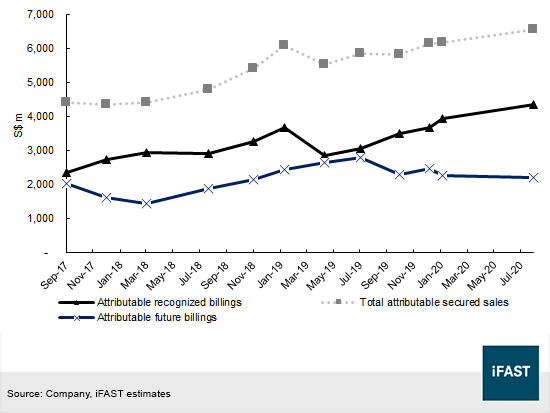
In the six months ended June (“2HFY20”), group revenue jumped 299% to S$638.9m on new contributions from its Pindan Group subsidiary and higher revenue from projects in Singapore, Cambodia and the UK. Total sales secured from launched projects rose from S$8.00 billion in February to S$8.57 billion and attributable secured sales grew from S$6.18 billion to S$6.55 billion (Figure 1). Attributable future progress billings, an indicator of future revenue, dropped slightly from S$2.24 billion to S$2.20 billion.
Figure 1: Sales secured, recognized billings and future billings
Gross profits increased 303% to S$149.3m but the developer made a net loss of S$288.0m in 2HFY20, down from a profit of S$62.2m in 2HFY19. This was due to a meaningful jump in other losses, which climbed from S$14.5m to S$324.9m. These losses were mostly attributed to (1) S$48.7m fair value loss in Singapore investment properties; (2) ~S$101m loss resulting from the disposal of its 18.8% interest in Galliard Group; (3) ~S$106m impairment of receivables relating to the Chevron House Retail Podium transaction; and (4) S$23.7 unrealized foreign exchange loss linked to the firm’s USD notes, due to the appreciation of USD/SGD. On a separate note, Oxley also disclosed that it had booked a S$70.3m loss on revaluation of properties, specifically the Novotel & Mercure Hotels on Stevens, in other comprehensive income.
Tangible assets
During FY2020, total assets decreased from S$6.10 billion to S$5.15 billion and PPE dropped from S$1.02 billion to S$944.6m. The Novotel and Mercure hotels along Stevens Road, which had a carrying value of S$953m on 30 Jun 19, is a large component of PPE. After accounting for the S$70.3m revaluation loss, we estimate the carrying value of the hotel as of 30 Jun 20 at ~S$882m.
Investment properties also registered a decline from S$571.1m in 2HFY19 to S$329.7m in 2HFY20. Besides the S$48.7m fair value loss on investment properties mentioned earlier, we think the decline was also attributable to the sale of commercial buildings at Dublin Landings in Ireland. The remaining investment properties would, in our view, primarily comprise of the industrial development Space@Tampines (2HFY19 carrying value: S$200m) and Novotel and Mercure on Stevens (2HFY19: S$100m).
An intangible asset of S$27.2m was recorded at the end of June and this is related to Oxley’s acquisition of the remaining 60% of Pindan Group in October 2019. As at 30 Jun 19, the net tangible asset value of Pindan Group was AUD 25.8m.
Cash flow discussion
Oxley’s cash flows have typically been unevenly distributed as customer payments follow a schedule dependent upon the achievement of project milestones. Usually about 20% to 30% of the sale price may be collected upfront, while the majority of remaining cash flows is received upon development completion.
In aggregate, Oxley’s operating cash flows have improved since 1HFY19 (Table 2). Net cash flows from operating activities increased to S$125.9m in 2HFY20 on the delivery of residential units in the UK and progress billings of Singapore projects. Free cash flows, which take into account net expenditures on PPE and investment properties, swung from negative S$108.4 in 2HFY19 to S$213.4m in 2HFY20. This was primarily because of the S$142.6m inflow connected to disposals of commercial properties at Dublin Landings in Ireland and 30 Raffles Place in Singapore.
Table 1: Operating cash flows
| 1HFY19 (S$ m) | 2HFY19 (S$ m) | 1HFY20 (S$ m) | 2HFY20 (S$ m) | |
|
Operating cash flows before working capital changes |
93.7 | -39.3 | 64.9 | 119.2 |
|
Net cash flows generated from operating activities |
-347.8 | 22.7 | -87.1 | 125.9 |
|
Free cash flows |
-366.4 | -108.4 | 57.6 | 213.4 |
| Source: Company, iFAST estimates | ||||
Liquidity and debt profile
As a consequence of large financing cash outflows, cash and cash equivalents dwindled to S$384.7m in 2HFY20 (2HFY19: S$474.4m). On the gearing front, group borrowings decreased during FY20 to S$3.02 billion (2HFY19: S$3.58 billion) as the redemption of loans, with proceeds from the Chevron House transaction, helped to reduce some of the firm’s debt pressure.
There was S$2.24 billion of non-current debt on 30 Jun 19, but this has fallen to S$1.27 billion at 30 Jun 20. In contrast, total short-term borrowings climbed from S$1.34 billion to S$1.75 billion over the same period. At S$1.75 billion, current borrowings as at 30 Jun 20 exceed the combined value of debt maturing in calendar years 2020 and 2021 (S$1.40 billion), as shown in Oxley’s FY20 results presentation slides. We think this can be interpreted as the company has successfully refinanced some of its near-term maturities subsequent to end-June.
At this juncture, we maintain the view in our May update that Oxley will be able to redeem its bonds upon maturity. Taking reference from the company’s latest guidance, we continue to believe that Oxley will meet the S$1.75 billion of current borrowings through its development proceeds, asset divestitures and loan refinancing (Figure 2). The company’s potential liquidity sources include (i) ~S$288.5m of unrestricted cash by our estimation; (ii) sale proceeds from Dublin Landings (S$111m), Royal Wharf (S$160m), Sea Pavilion Residences (S$15m), The Peak (S$217m), Sixteen35 Residences (S$34m); (iii) down payments of up to ~S$240.3m (25% of remaining GDV of S$961m) from the sale of remaining Singapore projects; (iv) sale of the land parcel at Walker Street (which could fetch ~S$90m as we understand from management); and (v) successful refinancing of the project debt and investment property loan due in 2020 and 2021 (S$665m).
Figure 2: Potential liquidity sources versus near-term debt
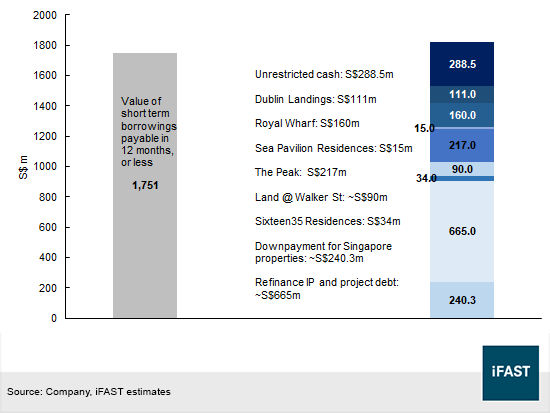
With regard to the land parcel at Walker Street, management explained that they are currently considering two options – either a land sale that would bring in ~S$90m or build a 24,000 square foot project with a gross development value (“GDV”) of S$446m. We also assumed that Oxley will be able to refinance its near-term secured debt as we think there is some debt headroom with the firm’s secured debt-to-asset ratio of 39.9%. Historically, this ratio reached as high as 43.2% on 31 Dec 18. In a response to SGX queries earlier this month, Oxley mentioned that negotiations for its asset-backed loans due in the near term are in progress.
Concerning details on The Peak in Cambodia, Oxley clarified in an exchange filing that the retail units have been handed over to buyers and the proposed podium was completed according to schedule. The majority of the buyers of the retail component (76% sold) have made their final progress payments. According to the company’s projections, the shopping mall should commence operation in the second quarter of 2021. Meanwhile, the residential and office components are expected to be completed in early 2021.
From Figure 2, we also assumed that Oxley will completely sell all its remaining projects in the Singapore portfolio, which had an attributable GDV of S$961m. In the event this does not materialize, we think Oxley will likely divest its Novotel and Mercure hotels. As we understand, the hotel is currently not accepting reservations and under contract with the Singapore government for the housing of suspected and recovering COVID-19 cases.
Oxley guided that the repayment for the OHLSP 5.700% 31Jan2022 Corp (SGD), OHLSP 6.500% 28Feb2023 Corp (SGD) and project debt due in 2022 will be met through the sale of Singapore projects. Contingent on the sale of all of the Singapore residential assets, we think the likelihood of timely repayment is satisfactory as the value of total attributable future progress billings of S$1,488m (Table 3), a proxy of future cash flow, is higher than its non-current debt (2HFY20: S$1.27 billion).
Table 3: Singapore properties completing in 3Q21 and beyond
| Project | TOP | Attributable Future progress billings | Remaining GDV |
|
1953 |
2Q22 | 45 | 57 |
|
Parkwood Residences |
1Q23 | 2 | 26 |
|
Affinity at Serangoon |
3Q22 | 279 | 168 |
|
Mayfair Gardens |
2Q22 | 209 | 63 |
|
Mayfair Modern |
2Q22 | 113 | 138 |
|
Riverfront Residences |
3Q22 | 333 | 77 |
|
Kent Ridge Hill Residences |
2Q22 | 347 | 372 |
|
The Verandah |
3Q21 | 150 | 2 |
|
INSPACE |
4Q21 | 10 | 56 |
|
Total |
1,488 | 959 | |
| Source: Company | |||
Bond valuation
With the abovementioned assumptions and points in mind, we think the OHLSP curve is attractively priced relative to other SGD credits (Figure 3). Yields of the company’s bonds are among the highest in the sector.
Figure 3: Relative valuation among comparable real estate SGD and USD notes
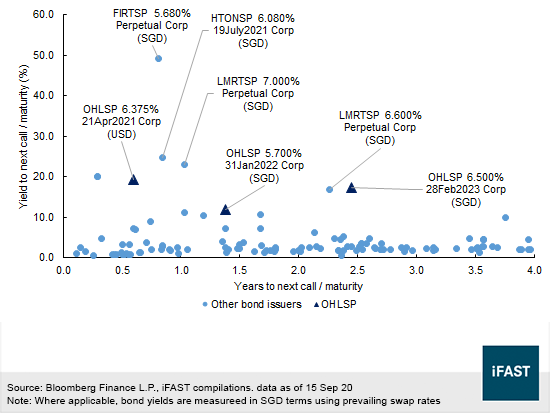
As an example, the OHLSP 6.375% 21Apr2021 Corp (USD) had a yield to maturity (“YTM”) of 18.9% at its ask price of 93.0 on 15 Sep 20. Other near-term high-yielding credits include the FIRTSP 5.680% Perpetual Corp (SGD) and LMRTSP 7.000% Perpetual Corp (SGD). We do not recommend these perpetual notes as their pricing does not seem to provide adequate compensation for the elevated risk that the notes might not be redeemed on first call – see “First REIT: Credit Update 30 Jul 20” and “Lippo Malls Indonesia Retail Trust: Credit Update (26 May 20)”.
Beyond 2021, we think the OHLSP 5.7% ‘22s and OHLSP 6.5% ‘23s also provide value for bond investors. As seen in Figure 3, these bonds offer meaningful yield and spread pick-ups against other credits. With indicative YTMs of 11.8% and 17.4% respectively, their current valuation may be suggesting a highly uncertain outlook for the issuer, but we think Oxley’s credit situation will improve once it tides over its immediate debt obligations.
Our concluding view
Taken as a whole, we trust that Oxley will sell and complete its current developments in a timely manner. A strong selling ability and quick monetization of assets will be crucial to alleviating the pressure on its credit profile. As a last resort, the firm may still divest its Singapore hotels for liquidity. The company has a good track record of meeting its deleveraging and cash-flow guidance, and the divestment of non-core assets has helped to lift the group’s cash flows. We think the price correction of Oxley’s bonds during the year has brought valuations to an appealing level. Consequently, we think the OHLSP curve provides a decent choice for investors with high risk tolerance looking for bonds maturing within the next three years.
Our new podcast series, Yield Hunters, is now available on Spotify, iTunes Podcasts, Google Podcasts. We share our thoughts on new bond issues and hold discussions on the fixed income space. Listen to our latest episode below and follow us!
Declaration:
For specific disclosure, at the time of publication of this report, IFPL (via its connected and associated entities) has a principal position in OHLSP 6.375% 21Apr2021 Corp (USD), FIRTSP 5.680% Perpetual Corp (SGD) and LMRTSP 6.600% Perpetual Corp (SGD). The analyst who produced this report holds a NIL position in the abovementioned securities.